
Community Also Honors Other Local Contributors with Installation of New Park Signage
AUSTIN, Texas – Nov. 17, 2025 – Mueller, the mixed-use, mixed-income community in the heart of Austin, announced today the renaming of the popular Lake Park to “Girard Kinney Park at Mueller.”
This renaming is to honor the local architect and Cherrywood leader best known for his decades-long advocacy and activism in the redevelopment of the former Robert Mueller Municipal Airport site, as well as his citywide accomplishments on projects, including Symphony Square, Zach Scott Theater’s Whisenhunt building, the Pfluger Pedestrian Bridge, and his leadership at Scenic Austin.
Kinney became a driving force in Mueller’s redevelopment through the Citizens for Airport Relocation, or CARE, effort to not only advocate for a new airport to be built elsewhere, but to also recommend how to redevelop the 700+ acres once the airport moved. Kinney then served as the neighborhood representative on the City’s Airport Advisory Board from 1984 to 1994.
He also chaired the RMMA Process and Goals Task Force in 1996, which informed the six primary goals that continue to shape Mueller nearly 30 years later. Additionally, he was hired by Mueller’s redevelopment team to conduct feasibility studies to reuse the historic Robert Browning Hangar and determine what it would take to allow future public access of the former airport control tower.
“Girard has had an impressive impact across the City of Austin over the last several decades. Most of us who live in and around Mueller will recognize his tremendous work and consistent presence to make Mueller the special place it is today,” said Jim Walker, a fellow Mueller redevelopment advocate and Cherrywood Neighborhood Association Chair. “Mueller is a much better place because of Girard’s commitment, passion and insight – particularly related to sustainability features and preservation of historic structures.”
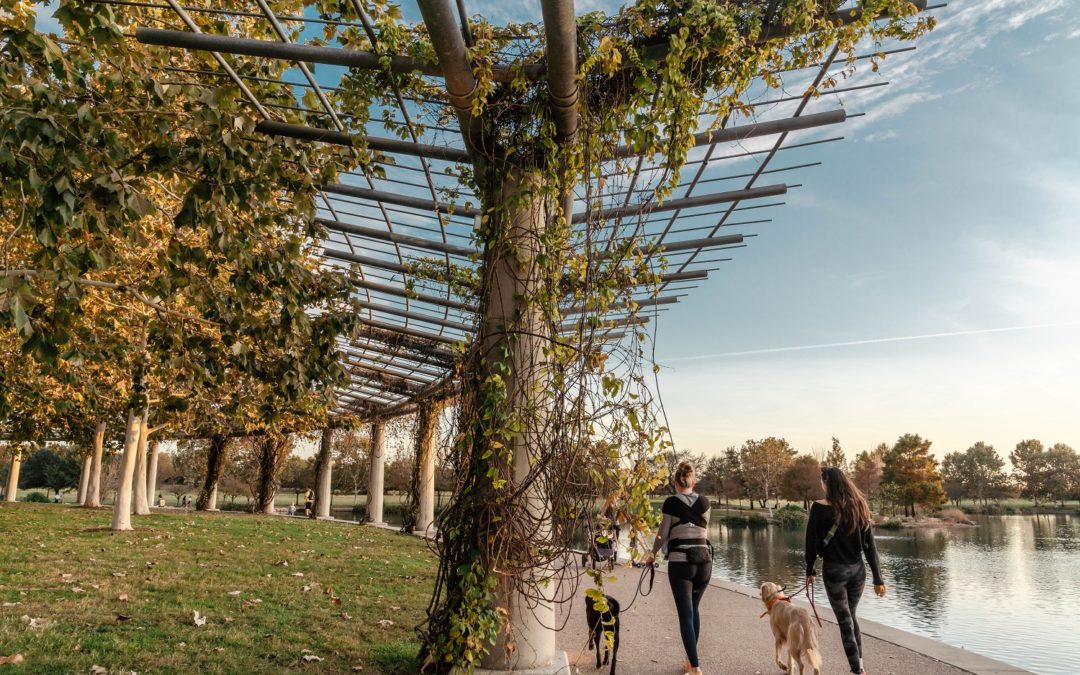
The park, which opened to the public in April 2007, is beloved by many for its unique, European-designed playscape, tree-shaded serpentine trail around a large, tranquil pond, large open space for a variety of sports or relaxing activities, and an amphitheater that hosts outdoor movies and concerts throughout the year. The park also serves as a popular destination for quinceañera, wedding, and graduation photos.
The renaming of Lake Park follows the recent opening of Mueller’s last open space, the Roger Lavon Taylor, Sr. Plaza, near the former airport’s iconic control tower. Mueller’s other parks are named after notable men and women who have made significant contributions in Austin’s history. Recently, these parks received permanent bronzed signage in both English and in Spanish that summarize their contributions.
These parks include:
- Ella Wooten Park, Opened in 2013: Named after the first woman to serve on the Greater Austin Chamber of Commerce board. Her pioneering role in a predominantly male-dominated arena paved the way for future generations of women in business and civic leadership in Austin.
- Paggi Square, Opened in April 2013: Named after Michael Paggi, an entrepreneur, ferry operator and landowner who brought ice manufacturing to Austin in the late-1800s. His innovation not only revolutionized local industry but also improved public health and quality of life in the region.
- John Gaines Park, Opened in July 2016: Named after Austin’s first African American police officer. In 1913, Officer Gaines was tragically shot while summoning help during a disturbance, highlighting the racial tensions and challenges faced by African American officers during that era. His service and sacrifice are also commemorated through a memorial at 401 E. 6th Street in Austin, Texas.
- Branch Park, Opened in May 2019: Honoring Mary Elizabeth Branch, the first female president of what is now known as Huston-Tillotson University, who was a staunch advocate for civil rights and education for African Americans in Austin.
- Jessie Andrews Park, Opened in November 2020: Named after the first female graduate and first female professor at the University of Texas at Austin. Her academic achievements and dedication to education, particularly in German and French, set a precedent for women in higher education. Beyond her academic contributions, Andrews was also a published poet and active in various civic organizations.
- Taniguchi Park, Opened in April 2024: Named for Isamu Taniguchi, a Japanese immigrant who, during World War II, was imprisoned with his family in South Texas. After their release, Taniguchi became a prominent figure in Austin’s cultural landscape, creating the Japanese Garden in Zilker Park.
- Roger Taylor Plaza, Opened in April 2025: Named after Roger Lavon Taylor, Sr., an African American community leader who played a pivotal role in preserving the historic control tower at the former Mueller Airport and was instrumental in the redevelopment efforts of the existing neighborhood.
“The extraordinary people who are honored as the namesakes of Mueller’s parks, in addition to those honored among Mueller’s street names, made significant achievements for and from Austin,” said Greg Weaver, the founder and CEO of Banbury Development, development manager for Catellus, Mueller’s development partner. “They serve as a testament to the diverse histories and legacies that have shaped the Austin-area for decades. The Mueller’s redevelopment team is proud to shine extra sunlight on their accomplishments with this collection of signs so even more people can learn about these extraordinary people.”
These parks, combined with other open space, such as the three nature-focused greenways that surround much of Mueller, now total nearly 140 areas. To learn more about Mueller and its parks, visit them in person or online at www.muelleraustin.com/park-events/.
# # #
About Mueller: Mueller is one of the nation’s most notable mixed-income, mixed-use communities located in the heart of Austin. The 700-acre site of Austin’s former airport is being transformed into a diverse, sustainable, compatible, revitalizing and fiscally responsible master-planned community. Mueller is a joint project between the Austin Financial Services and Catellus Development. Upon completion, Mueller will feature at least 6,900 single-family and multifamily homes (including more than 1,725 affordable homes), a mixed-use town center district known as Aldrich Street, approximately 4.8 million square feet of prime commercial space, including 737,000 square feet of local and regional retail space, 144 acres of public parks and open space, plus Dell Children’s Medical Center, the Austin Film Studios, The Thinkery children’s museum, H-E-B and the Austin ISD Performing Arts Center. Learn more on Facebook and Instagram.
About Catellus: Catellus is a national leader in mixed-use development, solving some of America’s most complex land challenges. With nearly 30 years of experience as a master developer, Catellus has transformed former airports, military bases and urban industrial sites into thriving retail, residential and commercial communities. These projects, which often include substantial public amenities, add economic, social and environmental value to the communities they serve. Catellus has both the financial strength and development expertise to turn vision into reality at even the most demanding development sites.
About Banbury Development: Banbury creates vibrant communities through comprehensive land and vertical development. The Arterra team brings an average of nearly 20 years of collaborative experience. As of 2025, the Banbury team has more than 1,150 acres of completed mixed-use projects and nearly 1,300 acres under development management in Austin, San Antonio, and Tempe. Banbury partners with both public and private landowners to craft purposeful spaces and prioritizes inclusivity and transparency in the development process. The Banbury team is committed to excellence in every project, often showcasing sustainability efforts, affordable housing, and other community benefits, from initial concept to final completion.
About Austin Financial Services: The City’s Austin Financial Services department (AFS) maintains the financial and economic integrity of the City of Austin and provides comprehensive, integrated financial management, administration and support services to City departments and other customers. AFS supports financial processes including preparing the annual fiscal report, managing procurement processes, handling franchise agreements, overseeing real estate and development transactions and monitoring the City’s investment portfolio and debt management. To learn more, visit austintexas.gov/fsd.